Home
Our ressources
Omnichannel consistency
&
Large corporations
AI-generated in-store posters: opportunity or risk for retailers?

AI-generated in-store posters: opportunity or risk for retailers?

Published on
00
min read
Omnichannel consistency
Large corporations
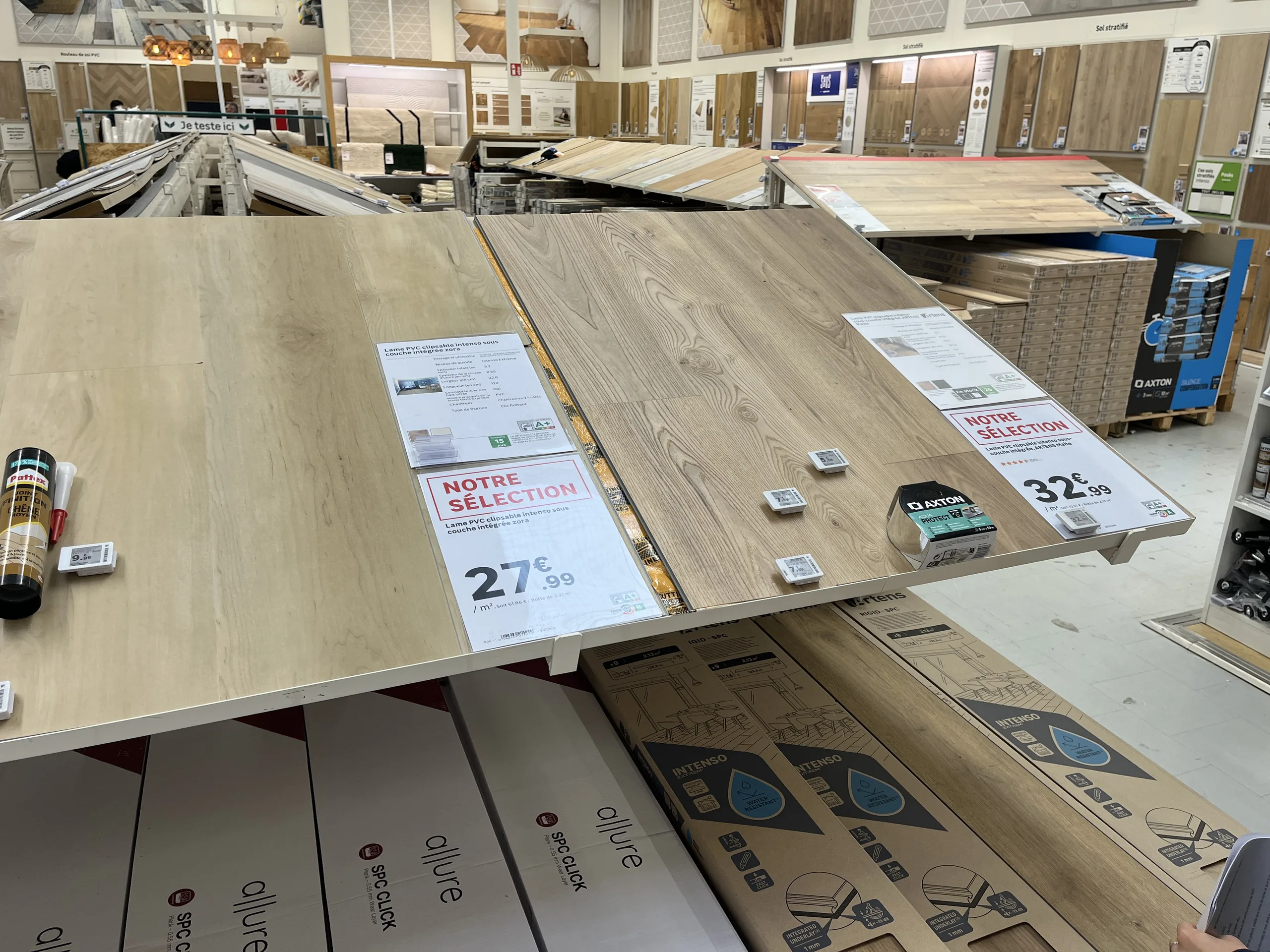
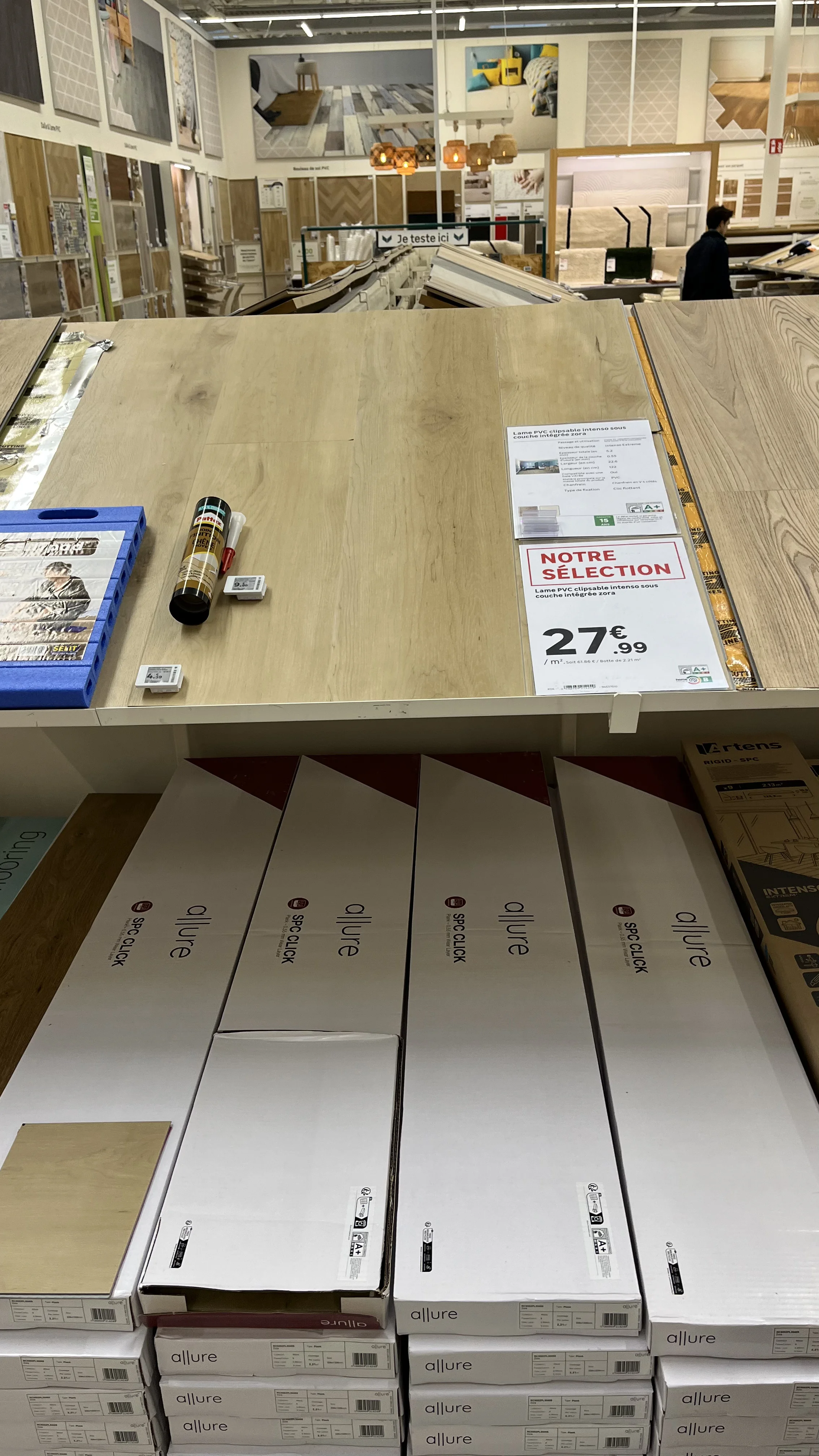
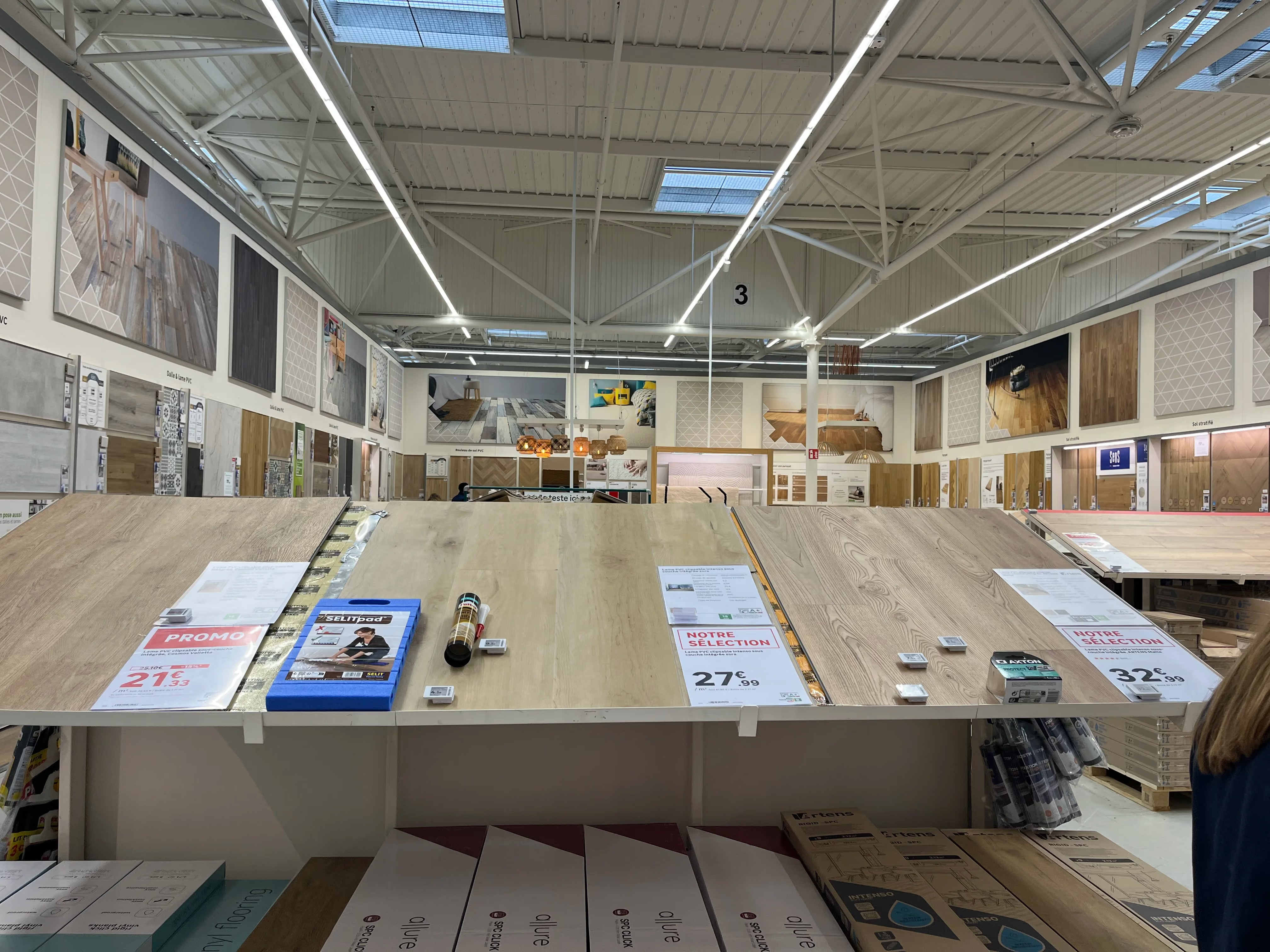
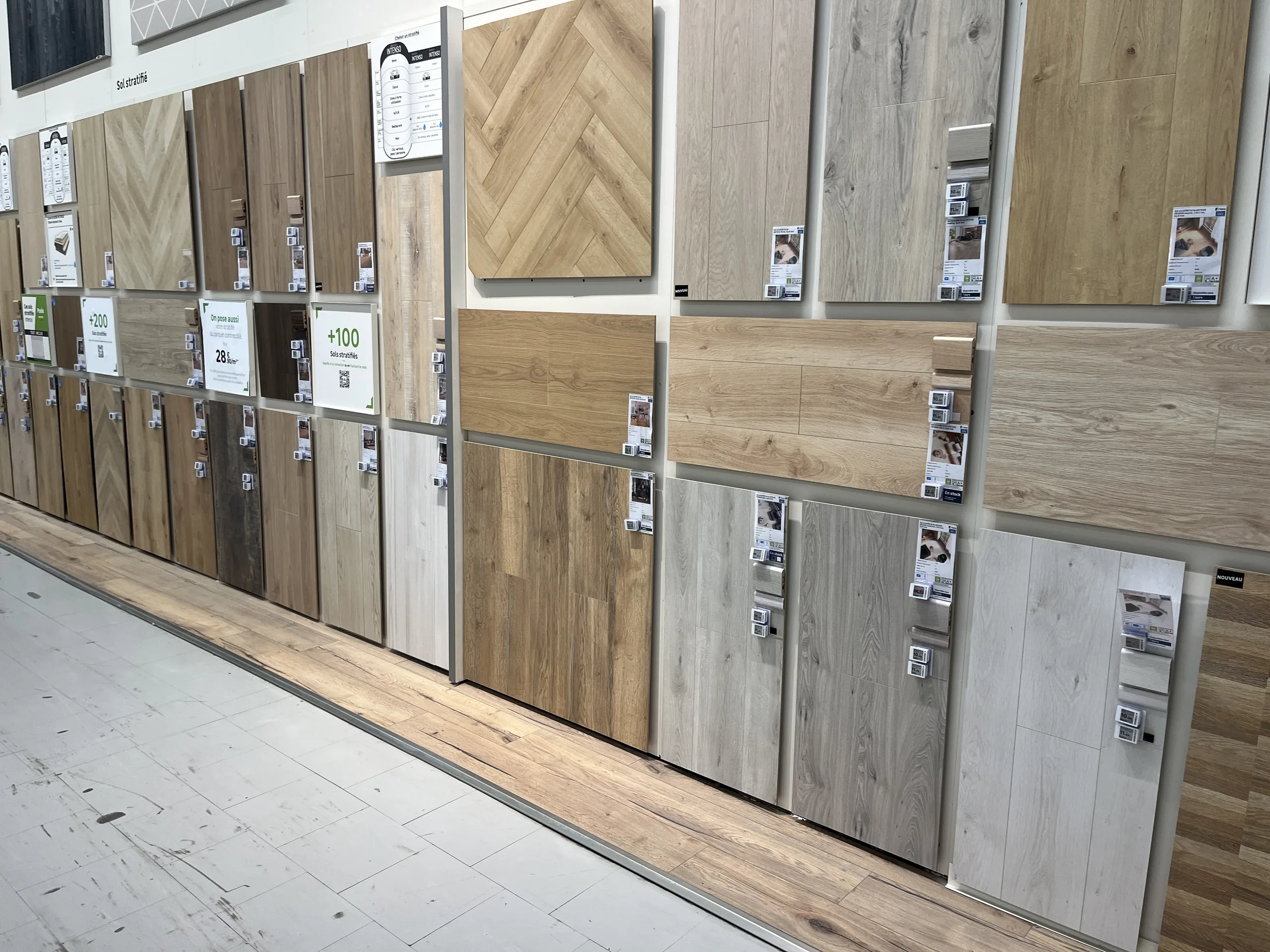
Laminate flooring display wall with a product sheet in the same format and electronic shelf labels under each sample
Table of contents

How can you ensure visual consistency across a retail chain?

Generative AI is making its way onto store posters. From brand guidelines, pricing accuracy, and mandatory legal notices to the cost of scaling across a network: here is what it really brings to the table, its limitations, and where it fits into the display creation process.

Should you generate your in-store posters with AI? Not for pricing and signage, at least not yet. While generative AI can quickly produce beautiful images, it cannot guarantee compliance with brand guidelines, the accuracy of prices and mandatory legal notices, or cost-effectiveness when scaled to millions of posters. However, it is useful in the early stages, helping creative teams develop the guidelines that the display tool will then apply across all stores.

The summer of 2026 may well be remembered as the time generative AI took over our walls. As the media outlet Next put it: "From major supermarket chains to smaller shops, generative AI is everywhere." The AFP reports the same trend: whether for advertising flea markets, municipal events, or supermarket promotions, AI-generated posters have been popping up all over France in recent months.
The temptation is understandable. In just a few seconds, an AI tool can produce a colorful, eye-catching visual that looks more polished than a manually designed poster. For a retailer, the question is serious: should you entrust your in-store posters to AI? Here is what we are seeing on the ground, and where we believe the real line should be drawn.

What we see: posters that look good on the surface, but are off-brand

The AI-generated posters appearing in stores often share the same flaws:

  • They do not respect the brand's visual identity : colors, fonts, and information hierarchy are reinvented with every single poster.
  • They erase brand identity : by relying on the same tools, AI posters end up looking identical. In fact, Next speaks of a "standardization of retailers, locations, and brands."
  • They don't always convince customers : the "AI-generated" aesthetic is becoming increasingly recognizable, and it is far from appealing to everyone.

The real problem isn't the image; it's the framework

Ultimately, an AI-generated in-store poster poses the same problem as an office template filled out by hand by a sales associate. The only difference is that the tool gives the illusion of doing a better job.
Because the problem has never been graphic quality. The problem is failing to respect the framework defined by the central marketing team. Without a framework, signage looks amateurish: it is less reassuring to the customer and less effective at driving sales.
This is why we advocate for a simple idea: it is better to have an imperfect framework, but a real one, than millions of more or less successful attempts that lack any consistency. This is also what allows forstandardize displays across an entire network, integrated as a franchisee.
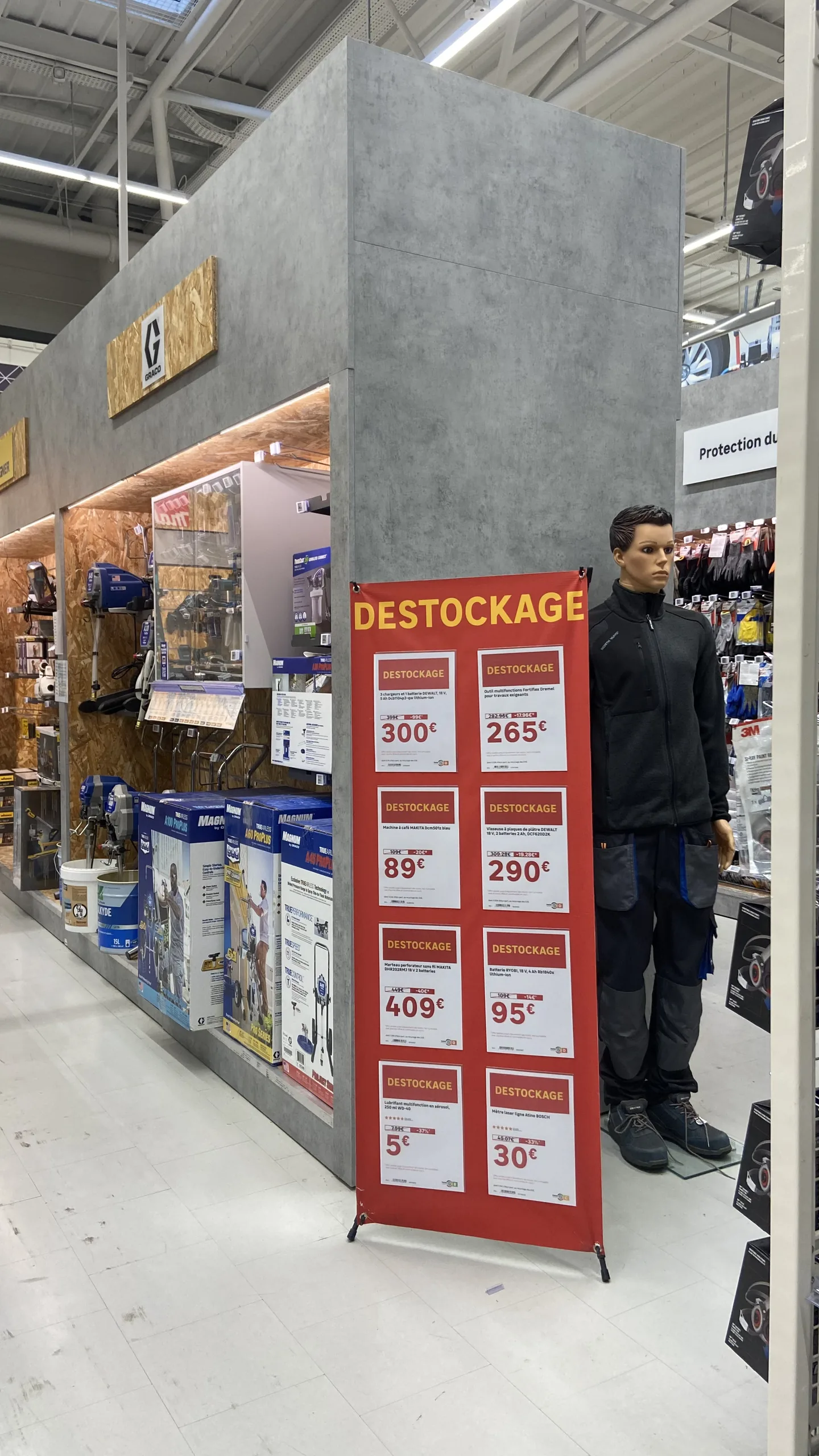
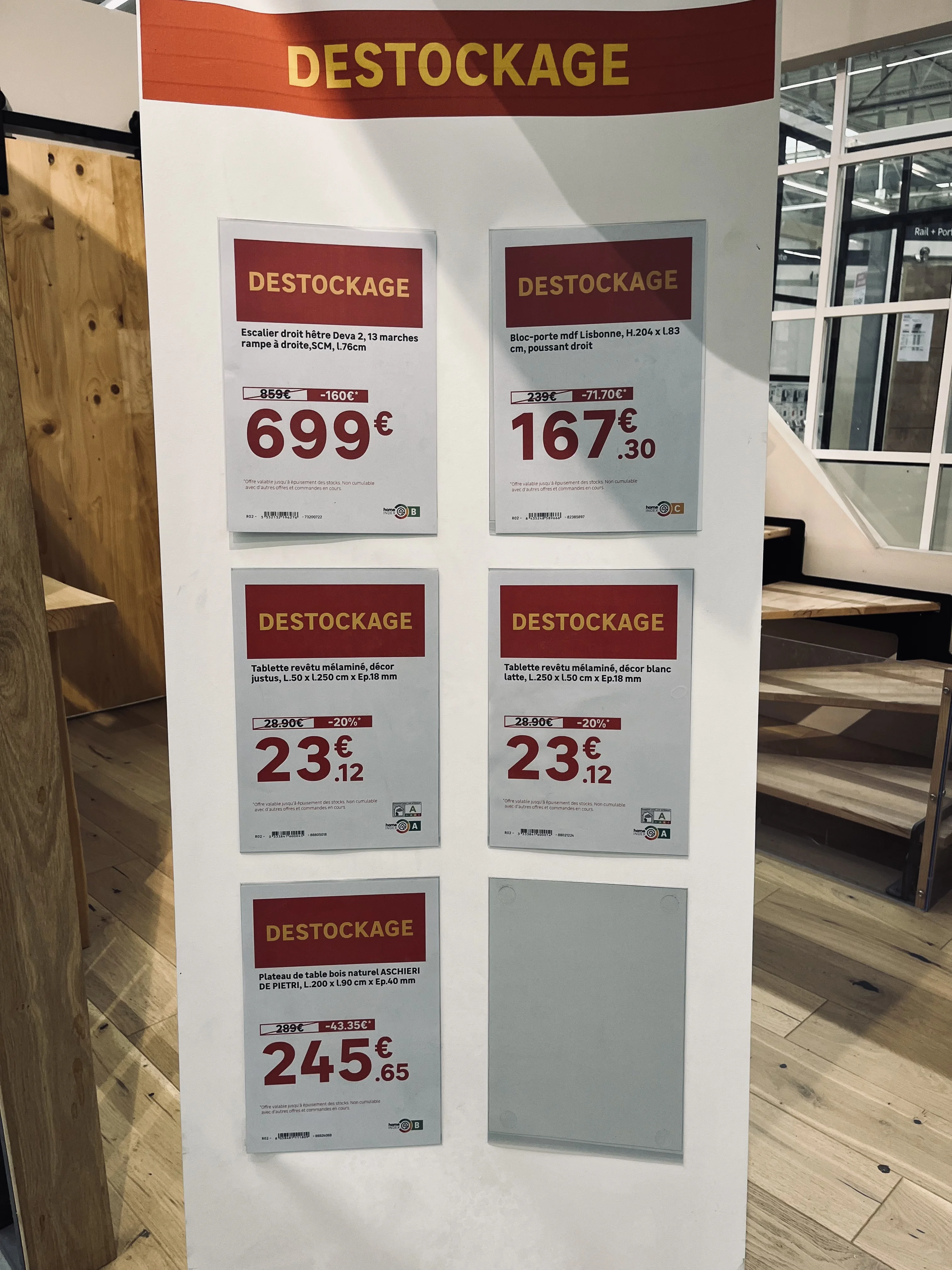
Red “Clearance” banner holding eight price signs built on the same template in a power tools aisle
The same template applied to every product: the consistency that generative AI cannot guarantee.

A price sign must be pixel-perfect

Generative AI is inherently random. While models are becoming increasingly controllable, two successive generations never yield the exact same result.

Yet, that is precisely what is expected of signage, labels, or shelf talkers: to be pixel-perfect, every single time, with zero room for chance. A promotional sign carries information that does not tolerate approximation: the reference price, the discounted price, the offer period, or the eco-participation fee. We have detailed these requirements in our article on the most common price display errors.
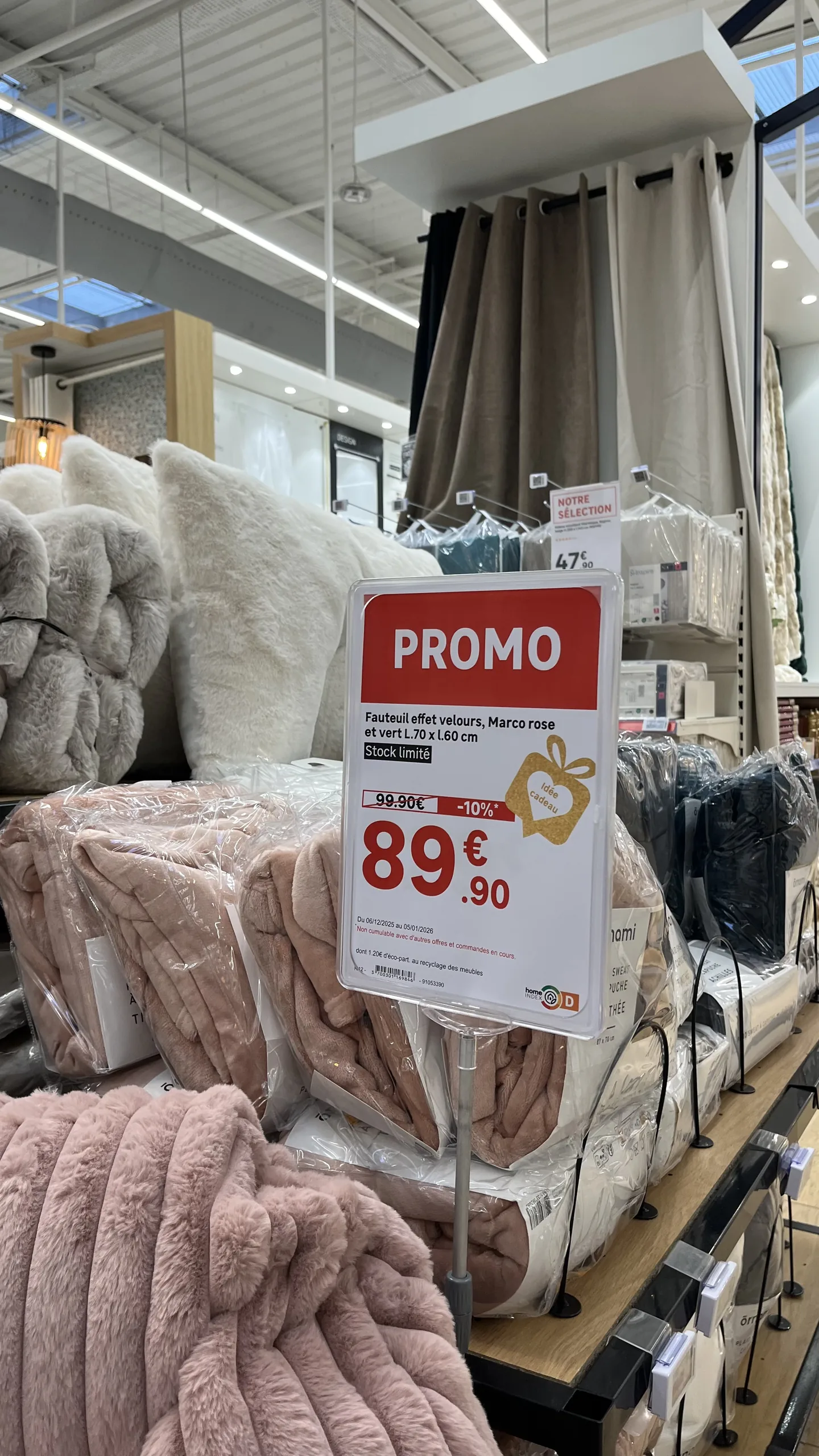
Promo sign on a stand showing a strikethrough price, a 10% discount, the promotional price, the offer period and the eco-fee
Reference price, discount, offer period, eco-participation: a promotional sign does not tolerate approximation.

There is also the issue of data. With a consumer-grade AI tool, you have to manually enter all the product information, and often make several attempts before getting a correct result. Every manual entry is an opportunity to get a price or reference wrong. Conversely, when signs are fed directly by the retailer's data, the displayed price is the one from the system, as explained in our article on automating label creation.

The hidden cost of AI at scale

The second obstacle is economic, and it is largely underestimated. Generating a sign with AI has a computational cost. Taken in isolation, this unit cost seems low. But a retail chain doesn't produce just a few signs: it produces hundreds of thousands. On a single Black Friday, the retailers we support can generate over 220,000 signs. Multiplied by such volumes, a minimal unit cost quickly becomes prohibitively expensive.
Ultimately, the equation is simple: adding an element of randomness that you don't want, at a much higher cost, makes no sense for producing signage.

AI-generated signs vs. data-driven signs: a comparison

Criterion
AI-generated sign
Data-driven sign
Brand guidelines
AI-generated signVariable, depends on the prompt
Data-driven signEnforced by the template set by head office
Prices and product information
AI-generated signTyped in by hand, with a risk of error
Data-driven signPulled from the PIM, ERP or point-of-sale system
Mandatory information
AI-generated signMust be checked on every sign
Data-driven signBuilt into the sign template
Consistency of output
AI-generated signSome randomness with each generation
Data-driven signPixel-perfect, every time
Speed in store
AI-generated signFull input, often several attempts
Data-driven signScan the item or enter its reference
Cost at scale
AI-generated signA computing cost for every sign, multiplied by volume
Data-driven signTemplates designed once, reused for every sign
Network consistency
AI-generated signEach store creates its own style
Data-driven signThe same framework in every store
AI remains useful upstream, to design brand guidelines and sign templates.

Where AI truly belongs: upstream of the sign

None of this means that AI has no place in in-store signage. It already does, but not where you might expect.
At headquarters, creative teams and graphic designers can leverage AI to design brand guidelines and sign templates. At PiiVO, we use AI ourselves to implement these guidelines in PiiVO POSter. AI therefore plays a role throughout the creation chain: to conceive the guidelines, and then to implement them in the tool.
However, once the sign template is defined, there is currently no need for AI to produce the sign itself: the product data and the brand guidelines are enough to generate it, accurate and identical in every store.

Why we didn't put AI in the hands of the sales associate

We are closely monitoring AI-generated signage and have already conducted several proofs of concept. We could have integrated AI directly into PiiVO for in-store sign creation. We chose not to, for a simple reason: it would be significantly more expensive without providing any benefit to the retailer. The goal is not for the sales associate to invent a new visual identity, but to apply the one designed by headquarters.
In the field, the fastest tool isn't necessarily the most "intelligent": with PiiVO, the sales associate scans the item or enters its reference number, and the sign is ready, featuring the correct branding, accurate data, and the right format.
The day AI becomes more affordable and predictable, we will be the first to use it for generating signage. That is not yet the case.

Before using AI for your in-store signs: the checklist

  1. Does the output respect your brand guidelines, for every single sign and not just on average?
  2. Do prices and product information come directly from your systems, or are they re-entered manually?
  3. Are mandatory disclosures guaranteed (reference price, offer period, eco-participation fees)?
  4. Is the result identical from one store to another, with no room for randomness?
  5. Is the cost sustainable at the scale of your network, over an entire year and during peak activity periods?

If any of these answers are no, AI likely belongs in the upstream design phase for your templates rather than in the production of your signs. To learn more, see our complete guide to in-store signage.

In summary

Generative AI has a clear role in graphic design, but not yet in the production of price signage. Signage must be accurate, compliant, and pixel-perfect across all stores, while remaining cost-effective at the scale of hundreds of thousands of signs. For now, this is guaranteed by the framework defined by headquarters, applied automatically using your data. AI is most useful upstream, where that framework is designed.

‍

Learn more

Managing your network's signage: //the 2026 best practices guide.//

Do you manage an integrated or franchise network? Discover our methodology for turning your signage into a driver of operational excellence. 25 pages of expertise, benchmarks, and practical checklists.

Download the white paper
Oops! Something went wrong while submitting the form.
Free resource
High-quality PDF format
Certified retail expertise
Frequently asked questions

Frequently asked questions about AI-generated in-store signage

Can generative AI be used to create in-store price posters?

While technically possible, it is not well-suited for current needs. AI does not guarantee compliance with brand guidelines, price accuracy, or consistent output across generations, and the costs become prohibitive when scaled to hundreds of thousands of posters.

What are the risks of using AI-generated signage for a retail brand?

A brand identity that is no longer consistent, a fading brand image, pricing or labeling errors caused by manual entry, and inconsistent displays from one store to the next.

Why is AI expensive for generating posters at scale?

Every generation has a computational cost. While low for a single poster, it becomes very high when a network produces hundreds of thousands of posters, for example during Black Friday.

Where is AI useful in creating in-store signage?

Upfront: to help creative teams design the brand identity and poster templates, and then to implement them in the display tool. Once the template is defined, product data is all that is needed to generate the poster.

What is the difference between an AI-generated poster and a data-driven poster?

The AI poster is created from a manually entered description, with a result that varies with each generation. The data-driven poster pulls information from your PIM, ERP, or POS system into a template set by headquarters, ensuring it is accurate and consistent across all stores.

Additional resources

To learn more

Omnichannel consistency
Large corporations

Why is automation the pillar of brand consistency?

Network consistency relies on centralizing assets at headquarters and automating their production using brand data. This approach eliminates discrepancies between headquarters and points of sale, freeing store teams from repetitive tasks. In a competitive market, this visual uniformity becomes a genuine brand asset.

00

min read

Every brand manager knows the feeling.

‍
Walking into one of your stores and sensing, from a single display detail, that something doesn't quite align with the national image. A hand-drawn sign, a poorly framed promotion, a stray price tag. It may seem minor, but that is often where the loss of consistency begins.

The stakes of brand image across a network

‍

An integrated network is built on a simple promise: the customer should have the same experience whether they walk into a store in Lille or Marseille. The operational reality is often different. Without a standardized tool, each point of sale ends up creating its own materials and signage to handle urgent shelf needs.

Take a department manager on a busy Friday evening without the right printed materials on hand. They open a word processor, cobble together a sign, print it, and put it up. They did their job; they handled the emergency. But multiply that action by hundreds of stores and dozens of occasions per year, and you end up with a visual patchwork that bears no resemblance to the polished identity intended by headquarters.

This is what we call local DIY: approximate fonts, distorted logos, and amateur layouts. In isolation, these deviations seem harmless. Accumulated across a large network, they dilute the national identity and weaken the perception of the brand's quality.

Manual vs. automated display management: what changes

‍

The contrast between manual and automated management is evident in five concrete aspects of daily network operations.

Visual consistency. With manual management, it varies from one store to another based on local habits. With automated management, it is identical across the entire network.

Brand guidelines. Left in the hands of each point of sale, they eventually get altered. Locked into centralized templates, they remain intact everywhere.

Price updates. When manual, they rely on re-entry, which is a source of errors and shelf discrepancies. When automated, they are synchronized directly from the brand's data.

Campaign deployment. It takes several days when each store produces its own materials. It drops to just a few hours when everything comes from a centralized production source.

Store team time. Absorbed by creating materials in the first scenario, it is refocused on sales and customer advice in the second.

This contrast sums up the challenge: automating signage is not just a cosmetic convenience, it is an industrial safeguard for your brand image.

Ending local DIY with automated templates

‍

To eliminate this inconsistency, the solution is not constant manual control, which is impossible to maintain across a large network, but rather providing intelligent templates. By centralizing templates at headquarters, the brand guarantees three things.

  • The brand identity is locked : fonts, colors, and logos are fixed within the templates and can no longer be altered locally.

‍

  • Content remains dynamic : each material is automatically populated with the correct prices, descriptions, and visuals, with no re-entry required.

‍

  • Autonomy is managed : the store retains the ability to produce its materials on demand, but always within the framework validated by headquarters.

This is the balance every network seeks: a nationally controlled image with flexible local execution.

Data synchronization: the right price everywhere, all the time

Connecting the brand's data streams—whether from the PIM, DAM, or ERP—to shelf labeling is the engine of this transformation. The major risk in retail remains the discrepancy between the displayed price and the price paid at checkout, a source of customer dissatisfaction and regulatory exposure. With automated production, data becomes live and reliable.

  • Zero manual entry : pricing data from the ERP flows directly to labels and signage, with no manual intervention required.

‍

  • Reliable display : price updates are automatically reflected across all relevant media, minimizing the risk of discrepancies on the shelf.

‍

  • Immediate responsiveness : price changes or promotional campaigns can be rolled out across the entire network in just a few hours.

Automation: a driver of overall performance

Beyond the visual aspect, automating signage is a key driver of profitability. By freeing department managers from time-consuming administrative tasks, the brand restores their primary mission: sales and customer service.

Automating signage isn't about taking away a team's role; it's about giving it back to them. A department manager didn't choose this career to recreate labels at a desk, but to bring their store to life and advise their customers. Giving this time back to the teams is arguably the most concrete—and human—benefit of this transformation.

In a sector where operational excellence makes all the difference, shifting from a culture of data entry to a culture of management is one of the best investments a network can make to sustain its growth and value its human capital.

Rayon de revêtements de sol avec des affiches « Notre sélection » posées sur les échantillons de parquet
Omnichannel consistency
Franchise networks

Corporate and franchise networks: harmonizing signage when every store has its own reality

Whether corporate or franchised, every store has its own reality. How do you maintain a common brand identity and data set while still allowing stores to manage their own pricing, formats, and local products, and move past the conflict between headquarters and the field?

00

min read

How can you harmonize signage across a retail network? By separating what must be consistent across all stores (brand guidelines, product data, mandatory disclosures) from what can vary locally (pricing, format, featured products). In a corporate network, headquarters can mandate this framework. In a franchise network, they must make it easier to follow than to bypass: when creating compliant signage takes only a few seconds, no one wants to do it by hand.

A single network, dozens or hundreds of stores, and just as many realities: different floor plans, different layouts, and different customer bases. And, depending on the network model, store managers with varying degrees of autonomy.
For headquarters, the goal is clear: ensuring customers find the same brand, the same identity, and accurate information from one store to the next. For the store, the goal is just as clear: display information quickly, in the right format, with the right price. Between the two, in-store signage is often the site of an age-old conflict. Here is how to overcome it, depending on whether the network is corporate or franchised.

Corporate vs. franchise networks: what changes for signage

In a corporate network, the stores are owned by the brand. In a franchise network, independent business owners operate the brand under contract. This legal distinction has a very concrete impact on signage: who has the final say.

Criterion
Company-owned network
Franchise network
Store ownership
Company-owned networkStores belong to the retailer
Franchise networkIndependent retailers run the brand under contract
Who decides on signage
Company-owned networkHead office sets the rules, with more or less leeway for each store
Franchise networkHead office offers a framework, franchisees keep some autonomy
What stays common
Company-owned networkBrand guidelines, product features, mandatory information
Franchise networkBrand guidelines, product features, mandatory information
What can vary
Company-owned networkPrice, format, featured products, depending on the initiative left to stores
Franchise networkPrice, format, featured products, local products
How to harmonise
Company-owned networkA clear framework, applied automatically by the tool
Franchise networkA tool that is easier to follow than to work around
The level of autonomy varies widely from one network to another, whether company-owned or franchised.

However, the line is not always so clear. A corporate network may grant its stores significant autonomy, and a franchise network can be highly structured. What matters is how the common framework is defined and then applied.

In a corporate network: a clear framework with room for initiative

Being a corporate network doesn't mean imposing everything from headquarters. At Leroy Merlin, for example, the company philosophy allows sales associates to take initiative: setting a price, choosing a product to highlight, or adapting a sign format to their specific department.
But these initiatives take place within a clear framework. Certain information comes from the central office and cannot be modified in-store:

  • Technical specifications of products, and those highlighted as priorities for a given product type.
  • Compliance icons and mandatory disclosures.
  • The brand guidelines, mandatory for the entire network.

This balance is what makes it work: real freedom for local operations, but none when it comes to the brand's image and the accuracy of information.

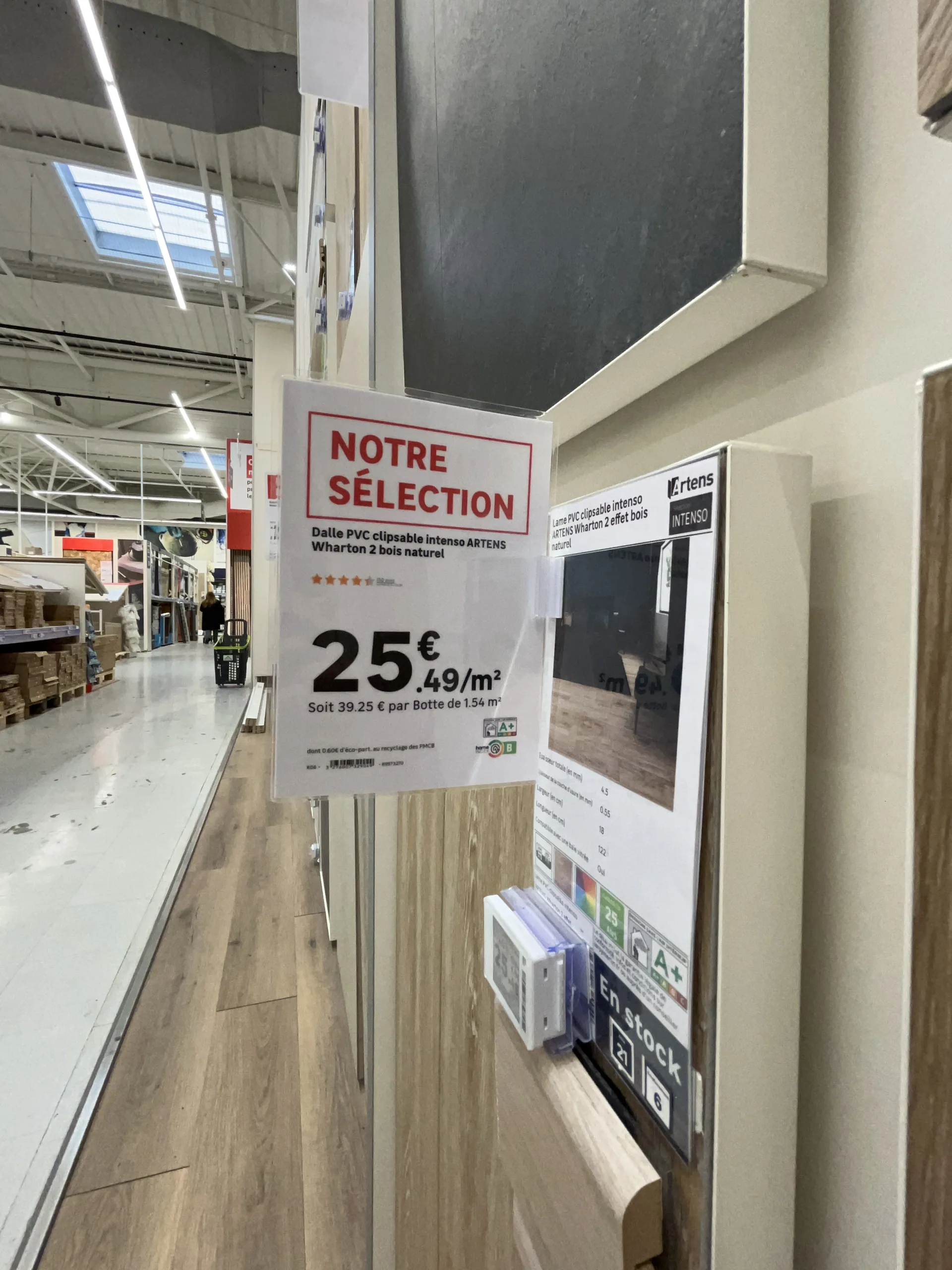
Affiche « Notre sélection » avec prix, caractéristiques produit et pictogrammes, accrochée à côté d’un échantillon de sol
The store chooses what to highlight, while the central office sets the guidelines and the product specifications to be displayed.

In a franchise network: persuade rather than impose

In franchising, the balance is more delicate. The level of autonomy in stores varies significantly from one network to another:

  • In some networks, franchisees are highly committed to the concept: they follow the brand guidelines, source most of their products from a central purchasing office, and decisions made by the franchisee council are then implemented in most stores.
  • In others, stores are completely independent and only follow the central marketing team if they are convinced of the value of the approach.

In these highly autonomous networks, no one can force a store manager to use yellow promotions instead of red. Nor is there anything to stop a store from continuing to display light bulbs in watts rather than lumens, as the head office decided, simply because their staff is used to it. In such cases, the marketing department cannot impose its will: it must offer tools that align with the stores' needs.

The eternal conflict between headquarters and the point of sale

Without the right tools, in-store signage creates frustration on both sides.
On the head office side
, marketing or merchandising teams design a global brand identity and ensure they have reliable data references. But in the field, the guidelines aren't followed and the displayed information is non-compliant. Each store does things its own way, often using office software templates.
On the store side
, the experience is just as painful. When signs are created by the central office or an agency, it can take a week to receive them. And when they arrive, the format doesn't fit the store layout, or the price is already outdated.
This isn't just a matter of convenience. A missing, incorrect, or late sign means a gap in sales, which directly impacts the store's revenue and margins.

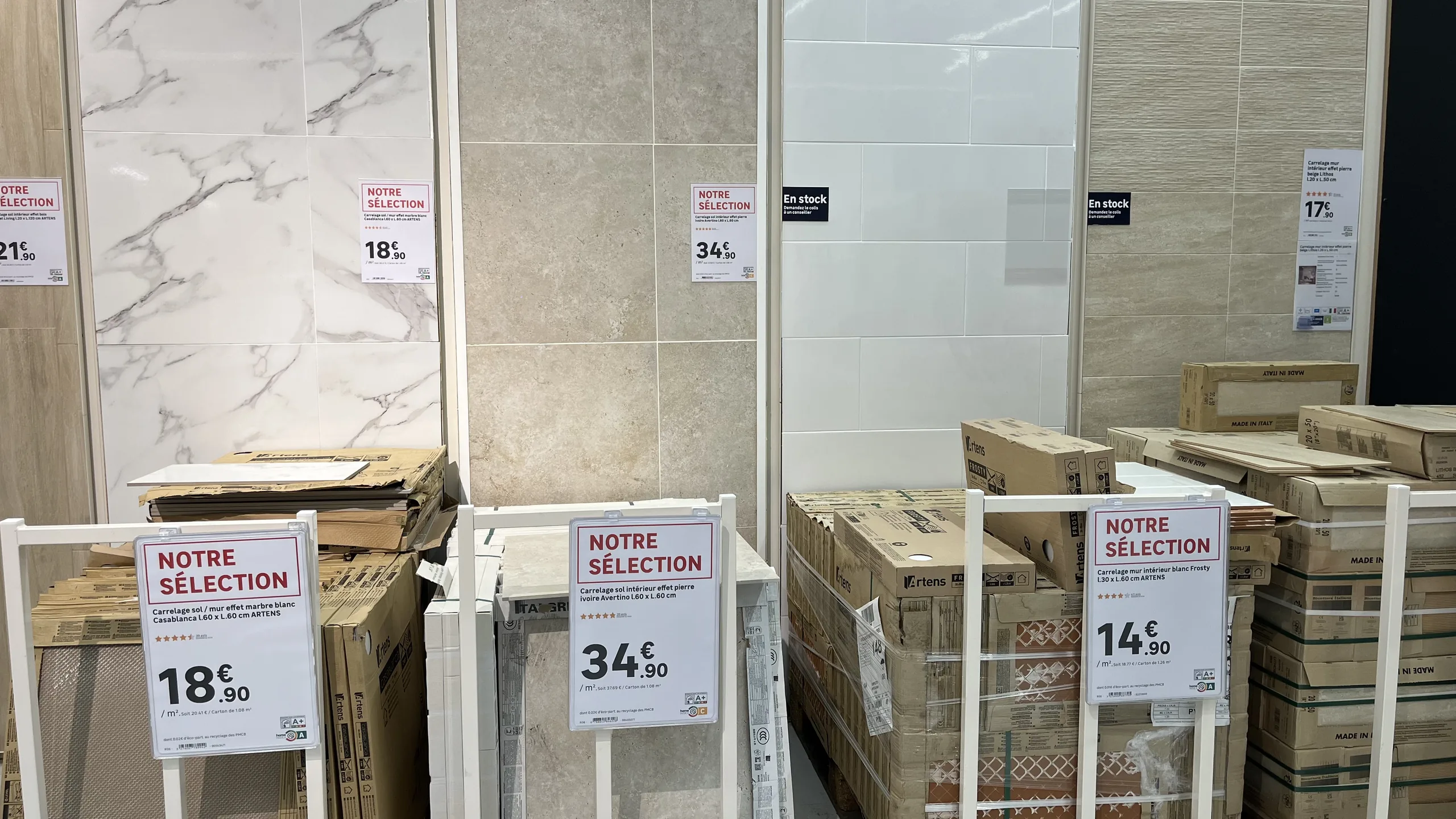
Rayon de carrelage avec plusieurs affiches prix « Notre sélection » identiques sur pied devant les produits
Consistent, up-to-date signage: what headquarters expects, what the store needs.

Gently enforcing the framework: simplicity as the best argument

The solution isn't to lock things down further. It's to make following the guidelines easier than bypassing them.
A tool like PiiVO POSter automates the creation of signage using brand data, in line with corporate branding. Stores can only customize what is truly useful on the ground, such as price or format. Everything else—product data and graphic standards—comes from headquarters.
The math is simple for the sales associate: a compliant sign is created in seconds and updates automatically if the price or price type changes, with no need for manual verification. Starting from an office template and redoing everything by hand becomes far too time-consuming. Even in a network where they have the freedom to do so, stores naturally stay within the guidelines.
Everyone wins: headquarters regains a consistent brand image, and the store saves time while displaying accurate information. This division of labor isn't set in stone; each brand defines it based on its own structure and the level of autonomy it grants its stores.

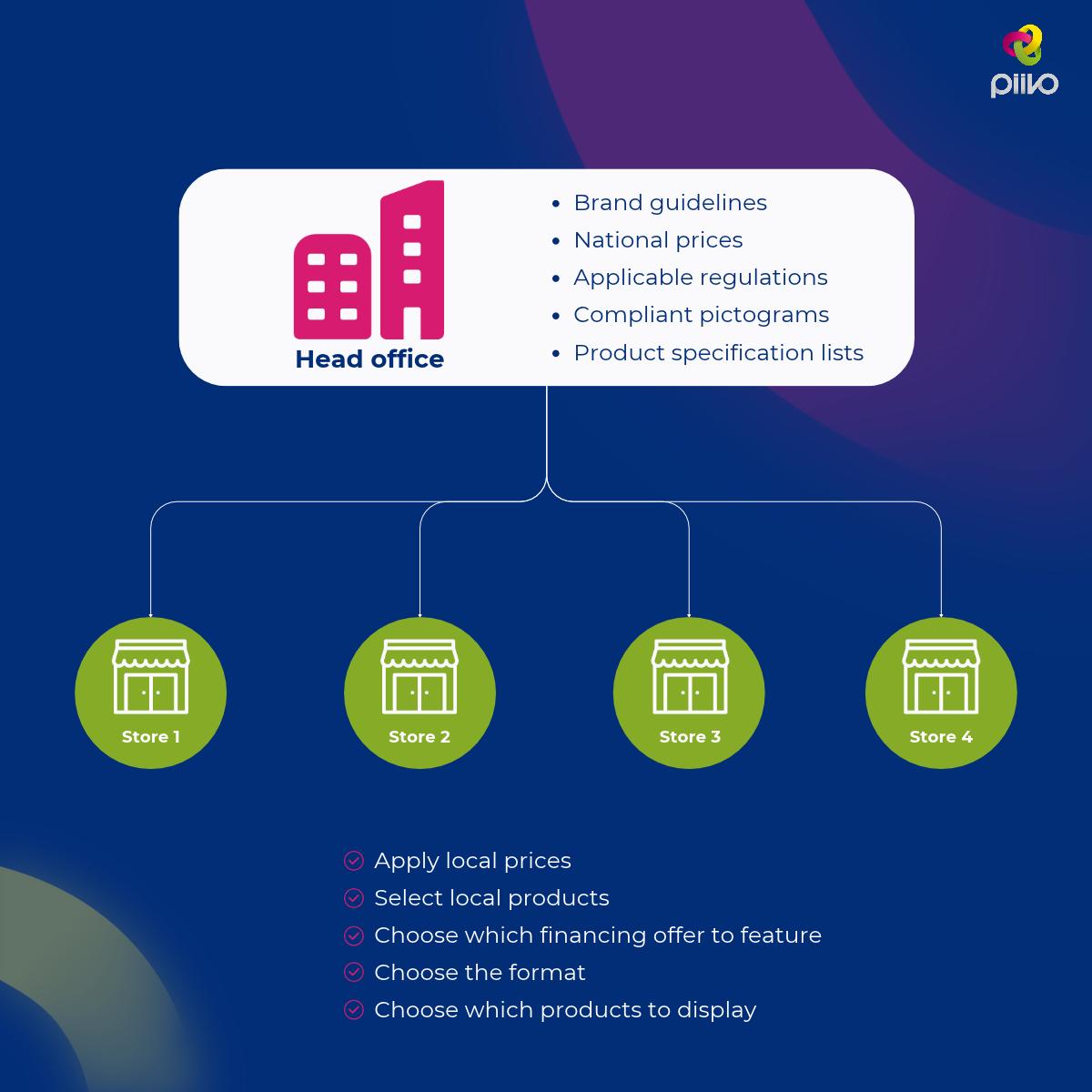
Diagram: head office sets the brand guidelines, national prices, applicable regulations, compliant pictograms and product specification lists; each store applies local prices, selects local products and chooses which financing offer to feature, the format and which products to display
Example of how one of our clients splits responsibilities between head office and stores. This split is fully customizable to meet each retailer’s needs.

Local products: maintaining consistency outside the national catalog

Franchisees often sell products that don't go through headquarters: local items selected by the store. These products fall outside national data, and that is where signage most easily goes off-track.
To bring them into the same framework, the platform connects directly to the store's point-of-sale system. It pulls local prices, identifies whether a product is national or local, and retrieves the correct data for each case.
The tool then acts as a guide. Take a sports store selling a locally sourced bike. By choosing the "technical bike" sign template, the associate is guided toward relevant features, such as the type of brakes (hydraulic disc or otherwise) or the derailleur (electronic or mechanical), using clean, compliant icons. Even for a product outside the catalog, the sign respects the branding and data framework set by headquarters.

How to harmonize signage across a network: the checklist

  1. Define what is common to the entire network: graphic standards, product features, and mandatory disclosures.
  2. Define what can vary in-store: prices, formats, and featured products.
  3. Populate signs with data from the brand, with no manual entry.
  4. Make the right sign faster to create than any workaround.
  5. Update automatically posters when a price changes.
  6. Also cover local products, by connecting to the stores' point-of-sale system.

To learn more about organizing signage across a network, see our complete guide to in-store signage, and our article on how to create successful POS and POP materials.

In summary

Whether integrated or franchised, a network needs a common framework for signage: a style guide, accurate data, and compliant disclosures. What changes is how you enforce it. The headquarters of an integrated network can mandate it; that of a franchise network must make it self-evident.
In both cases, the best lever remains the same: a tool that produces a compliant, up-to-date poster in seconds, while still allowing the store to manage the aspects that reflect its local reality.

‍

‍

‍

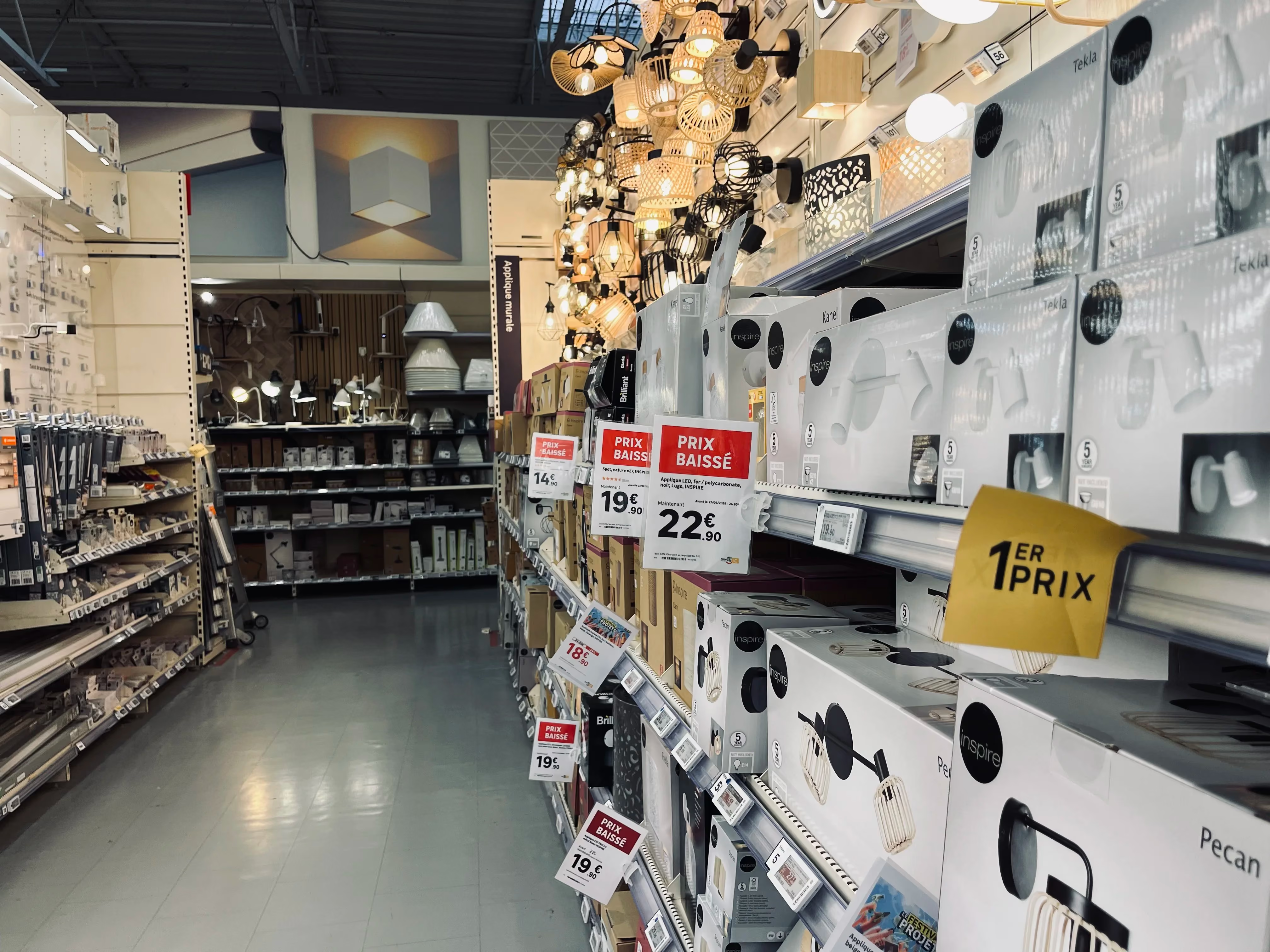
Allée de magasin avec affiches et étiquettes de prix suspendues au-dessus des rayons
Omnichannel consistency
Large corporations

In-store signage: the complete guide for retail networks

Posters, shelf labels, shelf talkers: in-store signage is the final link between a retailer and its customer. Discover what makes signage effective, the mistakes seen most often on the shop floor, and how a network can keep every display accurate and consistent at scale.

00

min read

What is in-store signage? In-store signage encompasses all the materials that inform and guide customers on the shelf: posters, price tags, shelf talkers, end-cap displays, banners, and electronic shelf labels. Successful signage is compliant with brand guidelines and regulations, features up-to-date pricing and product data, is error-free, and maintains impeccable graphic quality.

In a store, signage is the bridge between the offer decided at headquarters and the customer standing in front of the shelf. It informs, guides, and highlights. And when done poorly, it does the exact opposite: it misleads, undermines credibility, and becomes costly.
For a single store, the task is manageable. For a network of dozens or hundreds of locations, it becomes an industrial challenge. Here is what effective signage looks like, the most frequent mistakes in the field, and why automation is a game-changer at the network level.

What in-store signage covers

Signage refers to all communication materials placed in-store to inform customers about products, prices, and promotions. It is not limited to price tags: it covers everything that speaks to the customer on the shelf.
It is often confused with directional signage, which helps customers navigate the store, or with POS advertising, which promotes a specific brand. Signage, however, carries product information and pricing—the elements that legally bind the retailer.

Signage materials: what a network must manage

A retail chain constantly juggles several categories of materials, each with different constraints and production lead times.
Paper materials, which remain the most common:

  • Posters, from small formats to large promotional displays.
  • Shelf price tags.
  • Shelf talkers, which highlight a product from the aisle.
  • End-cap display materials, for the most visible locations.
  • Large-format banners, particularly for store exteriors.

Electronic shelf labels, which are updated remotely and are gaining ground in high-turnover departments.
Screen displays
, televisions, kiosks, and tablets capable of displaying visuals or documents. Their use remains more marginal in standard signage today.

Overhead retailer signage in a large format store
Large format signage, for retailer-wide messages.
Clearance posters with large price displays on a shelf
The promotional poster, produced in bulk for every campaign.
Paper price labels and an electronic shelf label side by side on a timber display
Paper and electronic labels often sit side by side on the same shelf.
Signage banner at the head of an aisle highlighting a product selection
Point-of-sale information, shaping the customer journey.
Price posters hanging above a store aisle
Overhead signage, visible from across the aisle.

The challenge is not producing one of these formats. It is producing the right ones, with the right data, at the right time, and consistently across the entire network.

The five criteria for successful signage

In the field, quality signage is recognized by five cumulative criteria. If even one is missing, the display loses its value or even becomes a liability.

  1. Compliance with the brand's visual identity. The display must respect brand guidelines, regardless of which store produces it.
  2. Regulatory compliance. Mandatory information must be present and accurate, including prices, units, and legal disclosures based on the product category.
  3. Up-to-date data. The displayed price must match the price at the register, and product information must accurately reflect the current offer.
  4. Flawless copy. A spelling mistake on an in-aisle sign directly damages the brand's credibility.
  5. Impeccable graphic quality. No pixelation, clean framing, and accurate colorimetry.

The most common signage errors

These errors almost never stem from a lack of diligence by the teams. They occur because, without the right tools, each store recreates its signage manually, in a rush, using data entered by hand.
Outdated pricing. This is the costliest error, as it creates a discrepancy between the shelf and the register, posing an immediate commercial and regulatory risk.
Failure to follow brand guidelines. Adding a visual that violates brand guidelines, using an approximate color, or improvising a layout: the network loses its consistency, and each store ends up with its own identity.
Inconsistent product data. The classic scenario: headquarters decides to communicate a feature in a specific unit, and the store uses another. The customer then compares information that cannot be compared from one aisle to another, or from one store to another.
Spelling mistakes, which go unnoticed during creation but jump out at the customer.
A promotional price higher than the original price. The most embarrassing error, which turns a sales campaign into an argument against the brand. This type of blunder spreads quickly on social media, where retail observers regularly post photos of these inconsistencies.
The common thread in all these errors: they arise the moment information is re-entered manually instead of being pulled from the source.

The real challenge: scale

What makes signage difficult in a network is not the complexity of a poster. It is the volume, concentrated over short periods.
The orders of magnitude observed at retail chains show the scale:

  • More than 220,000 posters generated in a single day across a chain of stores during Black Friday.
  • 160,000 posters produced by a major home improvement retailer for a single Black Friday event.
  • 3,000 posters per day on average for a distributor, which is nearly 100,000 per month.
  • 10,000 signs per day during a standard period at another retailer, or 300,000 per quarter.

At these volumes, manual production is no longer an option. The bottleneck isn't the store; it's the ability to quickly generate accurate, compliant, and consistent signage.

Vue large d'un showroom de magasin avec de nombreux supports de balisage en place

Manual vs. automated signage: what changes

Criterion
Manual signage
Automated signage
Volume handled
Manual signageLimited by the time available in store
Automated signageThousands of displays generated in a single run
Price accuracy
Manual signageRisk of a gap between the shelf and the till
Automated signagePrices taken straight from the retailer's systems
Brand compliance
Manual signageVaries from one store to the next
Automated signageCentral templates, consistency guaranteed
Product data
Manual signageRe-entered by hand, exposed to errors and typos
Automated signageTaken at source, consistent across the network
Print quality
Manual signageDepends on each team's time and resources
Automated signageConsistent output, true to approved templates
Network rollout
Manual signageStore by store
Automated signageIn one go across every point of sale
Volumes and observations drawn from PiiVO retail customers, for guidance only. Results vary with network size and the type of campaign.

How automation solves the problem

Automating signage isn't about producing the same materials faster. It's about eliminating the step that causes errors: manual data entry.
Data is pulled directly from the source.
Pricing, product names, specifications, and mandatory disclosures come straight from the retailer's systems. What is displayed on the shelf therefore matches what is actually in the system.
Templates are centralized.
Headquarters defines the templates, ensuring they comply with brand guidelines and regulations. Stores don't recreate anything; they generate. Network consistency is guaranteed by design.
Deployment is global.
A campaign is launched simultaneously across all relevant stores, rather than depending on the availability and diligence of individual teams.
Teams are freed up.
Time previously spent creating signage is returned to sales and customer service, especially during peak periods.

In summary

Signage is not just a minor execution detail; it is the final link between a retailer's commercial strategy and its customers. Accurate signage inspires confidence, while sloppy signage casts doubt on everything else.
For a retail network, the goal is not just to make prettier posters, but to ensure that every piece of signage in every store is compliant, up-to-date, and consistent, regardless of the production volume. This is precisely what data-connected signage automation enables.

‍

‍